Research summary
Retatrutide: what the published trials report
Retatrutide is a single peptide that acts at three receptors: GIP, GLP-1 and glucagon. It has been tested in phase 1, phase 2 and phase 3 trials, and the results below are what those papers report.

What is retatrutide?
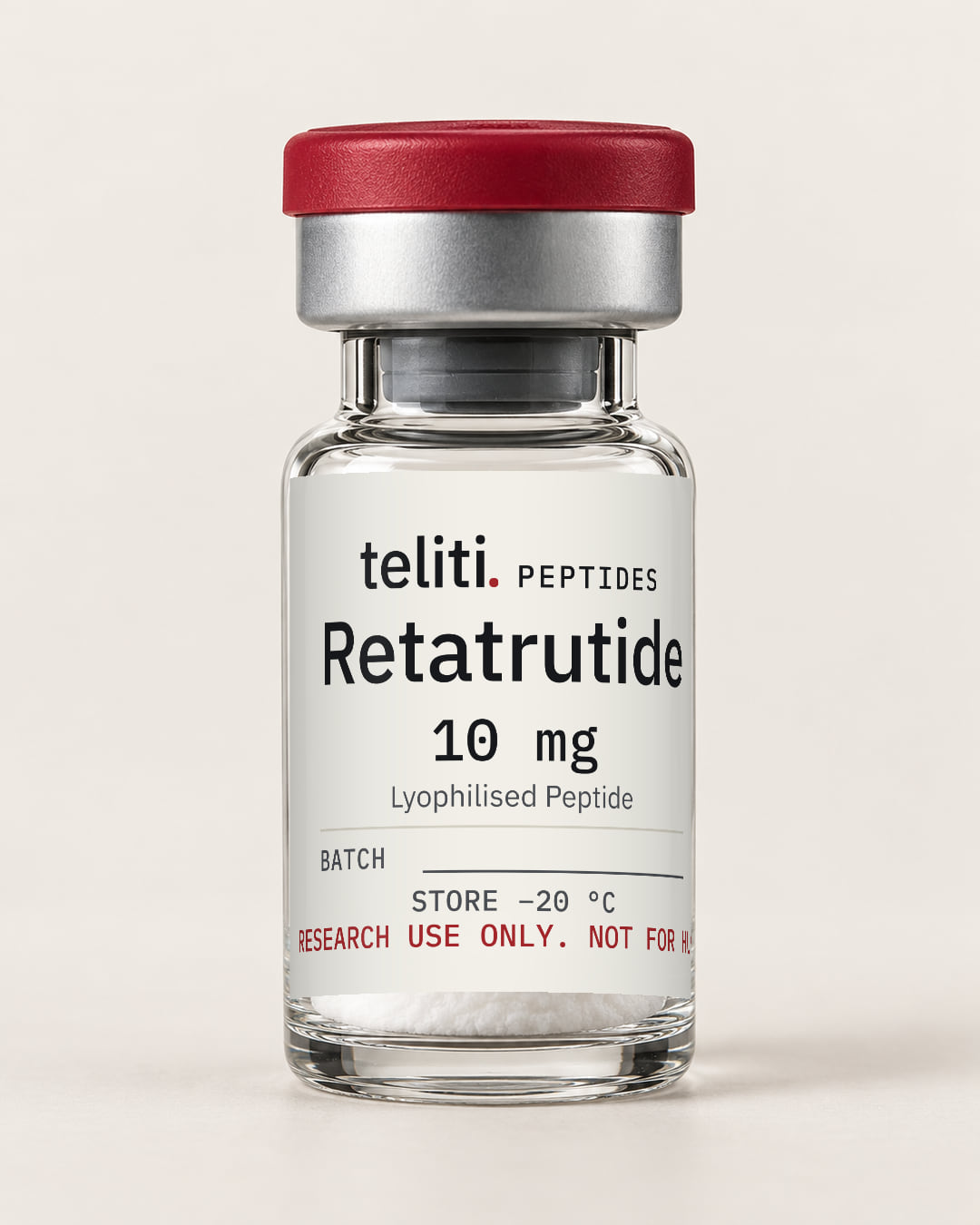
Retatrutide, coded LY3437943 during development, is a synthetic peptide of 39 amino acids carrying a fatty-acid side chain. It was designed to act at three hormone receptors at once: the receptors for glucose-dependent insulinotropic polypeptide (GIP), glucagon-like peptide-1 (GLP-1) and glucagon. That makes it a triple agonist, where the earlier peptides in this family act at one receptor (GLP-1) or two (GIP and GLP-1). Its identity data, from PubChem, are on the retatrutide page.
Why does it target three receptors?
The discovery paper, published in Cell Metabolism in 2022, describes the reasoning. In obese mice, activity at the GIP and GLP-1 receptors was linked to reduced food intake, while the glucagon-receptor component was linked to increased energy expenditure. The same paper reports a phase 1 single-dose study in people whose pharmacokinetic profile supported once-weekly dosing in later trials.
What did the phase 2 trials measure?
Two phase 2 trials were published in 2023. In the New England Journal of Medicine, a 48-week trial in 338 adults with obesity compared several doses against placebo. The Lancet published a trial in adults with type 2 diabetes that compared retatrutide with placebo and with dulaglutide, using the change in HbA1c at 24 weeks as its primary endpoint. A 98-participant substudy of the obesity trial, reported in Nature Medicine in 2024, measured liver fat. The cited-studies list below gives each trial's reported figures.
What did the phase 3 trial report?
The first phase 3 result, the 80-week TRIUMPH-1 trial in 2,339 adults, was published in the New England Journal of Medicine in 2026. Across the trials, the most common adverse events were gastrointestinal, and they were related to dose.
What is not yet known?
The published trials are of the manufacturer's clinical material, given under trial protocols. They do not describe research-grade material from other sources, and they do not establish long-term effects beyond the trials' durations. No marketing authorisation was found for retatrutide at the time this summary was written.
How does it compare with tirzepatide?
For how retatrutide differs from the dual agonist tirzepatide in structure, targets and evidence, read retatrutide vs tirzepatide.
Cited studies
-
Described in vitro receptor activity, effects in obese mice, and a phase 1 single-ascending-dose study with a pharmacokinetic profile supporting once-weekly dosing.
LY3437943, a novel triple glucagon, GIP, and GLP-1 receptor agonist for glycemic control and weight loss: From discovery to clinical proof of concept.. Cell Metabolism, 2022. doi:10.1016/j.cmet.2022.07.013 · PubMed 35985340
-
In a 48-week phase 2 trial in 338 adults, mean body-weight change was -24.2% at 12 mg versus -2.1% with placebo; adverse events were mostly gastrointestinal and dose-related.
Triple-Hormone-Receptor Agonist Retatrutide for Obesity - A Phase 2 Trial.. New England Journal of Medicine, 2023. doi:10.1056/NEJMoa2301972 · PubMed 37366315
-
A phase 2 trial in adults with type 2 diabetes compared retatrutide, placebo and dulaglutide, with change in HbA1c at 24 weeks as the primary endpoint.
Retatrutide, a GIP, GLP-1 and glucagon receptor agonist, for people with type 2 diabetes: a randomised, double-blind, placebo and active-controlled, parallel-group, phase 2 trial conducted in the USA.. The Lancet, 2023. doi:10.1016/S0140-6736(23)01053-X · PubMed 37385280
-
In a 98-participant substudy, mean relative liver-fat change at 24 weeks was -82.4% at 12 mg versus +0.3% with placebo.
Triple hormone receptor agonist retatrutide for metabolic dysfunction-associated steatotic liver disease: a randomized phase 2a trial.. Nature Medicine, 2024. doi:10.1038/s41591-024-03018-2 · PubMed 38858523
-
In the 80-week phase 3 TRIUMPH-1 trial (2,339 adults), mean body-weight change was -25.0% at 12 mg versus -3.9% with placebo; gastrointestinal events were most common.
Retatrutide, a Triple Hormone Receptor Agonist, for Treatment of Obesity.. New England Journal of Medicine, 2026. doi:10.1056/NEJMoa2604169 · PubMed 42814954