Research summary
BPC-157: what the published research reports
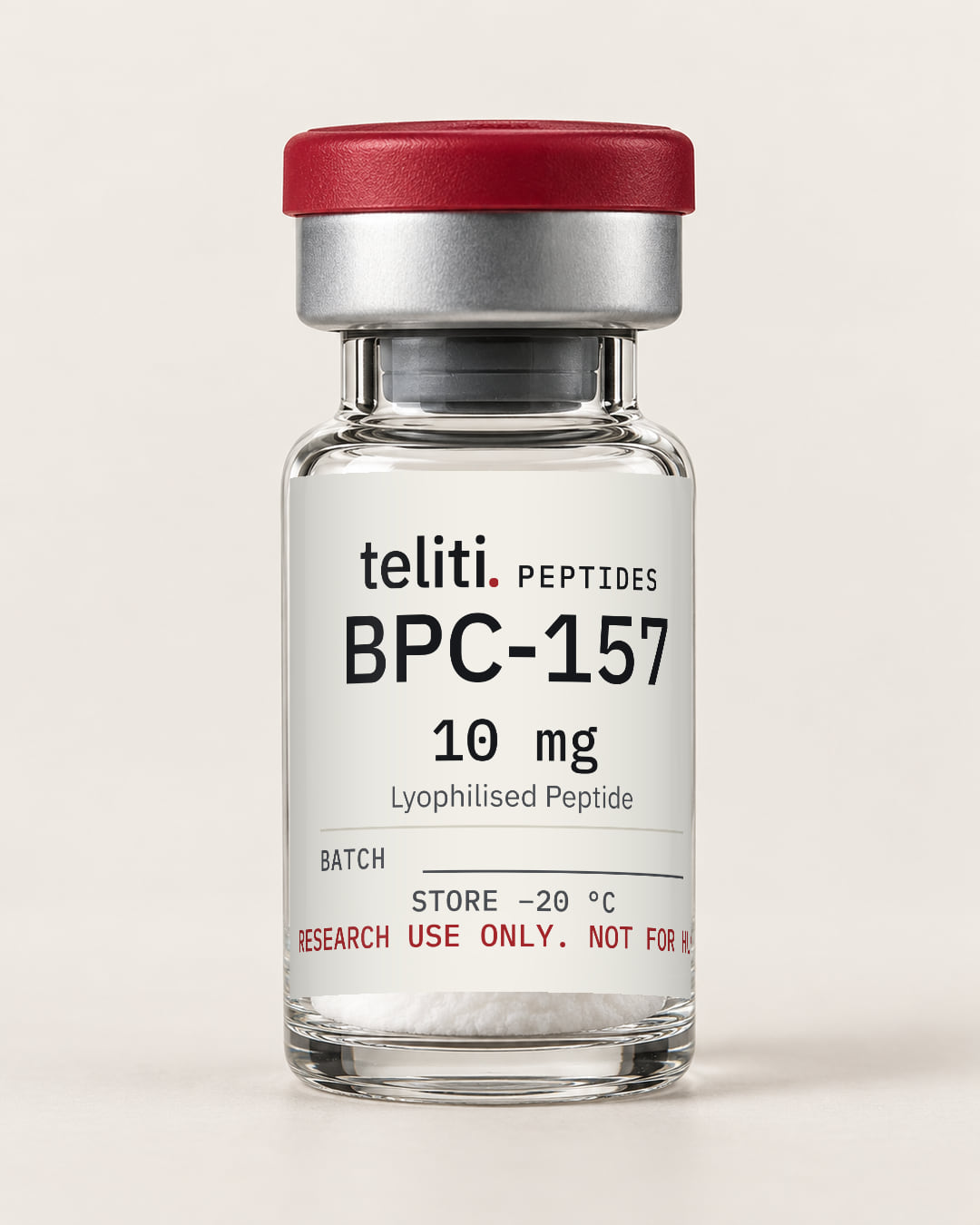
BPC-157 is a synthetic 15-amino-acid peptide studied mainly in cell culture and rodent models of tissue injury. A 2025 review found only three small human pilot studies and called it investigational.

What is BPC-157?
BPC-157 is a synthetic pentadecapeptide, a chain of 15 amino acids, whose sequence comes from a protein found in gastric juice. The name stands for body protection compound. Its identity data, from PubChem, are on the BPC-157 page. PubChem's record describes the free peptide; suppliers often sell an acetate salt, which has a different CAS number.
How strong is the evidence?
Most published studies of BPC-157 are in cells or animals, and many come from a small number of research groups. The findings below should be read with that in mind: an effect in a rat tendon explant or a chick membrane assay is a laboratory observation, not a result in people.
What do the tendon studies report?
A 2011 study in the Journal of Applied Physiology looked at rat tendon explants and cultured tendon fibroblasts. A 2014 paper in Molecules followed it up with a gene-expression analysis of the same cell type, in which the growth hormone receptor was among the genes most increased.
What do the blood-vessel studies report?
A 2017 study in the Journal of Molecular Medicine examined angiogenesis, the growth of new blood vessels, in a chick chorioallantoic membrane assay and in tube-formation assays, and looked at signalling through the VEGFR2 receptor in human endothelial cells.
Has it been studied in people?
A 2025 narrative review in Current Reviews in Musculoskeletal Medicine surveyed the field. It found broad preclinical data, identified only three human pilot studies, and concluded that BPC-157 should be considered investigational until well-designed clinical trials are done.
Is BPC-157 an approved medicine?
BPC-157 is not an approved medicine. For how it differs from thymosin beta-4 and the TB-500 products sold under that name, read BPC-157 vs TB-500.
Cited studies
-
BPC 157 accelerated outgrowth of rat tendon explants and increased migration and survival under H2O2 stress of cultured tendon fibroblasts, without a direct effect on proliferation.
The promoting effect of pentadecapeptide BPC 157 on tendon healing involves tendon outgrowth, cell survival, and cell migration.. J Appl Physiol (1985), 2011. doi:10.1152/japplphysiol.00945.2010 · PubMed 21030672
-
cDNA microarray analysis showed growth hormone receptor among the most up-regulated genes in BPC 157-treated rat tendon fibroblasts, with dose- and time-dependent increases in mRNA and protein.
Pentadecapeptide BPC 157 enhances the growth hormone receptor expression in tendon fibroblasts.. Molecules, 2014. doi:10.3390/molecules191119066 · PubMed 25415472
-
BPC 157 increased vessel density in chick chorioallantoic membrane and tube-formation assays, and increased VEGFR2 expression and VEGFR2-Akt-eNOS signalling in human endothelial cells.
Therapeutic potential of pro-angiogenic BPC157 is associated with VEGFR2 activation and up-regulation.. J Mol Med (Berl), 2017. doi:10.1007/s00109-016-1488-y · PubMed 27847966
-
The review summarised broad preclinical data, identified only three human pilot studies, and concluded that BPC-157 should be considered investigational pending well-designed clinical trials.
Regeneration or Risk? A Narrative Review of BPC-157 for Musculoskeletal Healing.. Curr Rev Musculoskelet Med, 2025. doi:10.1007/s12178-025-09990-7 · PubMed 40789979