Research summary
Tesamorelin: what the published research reports
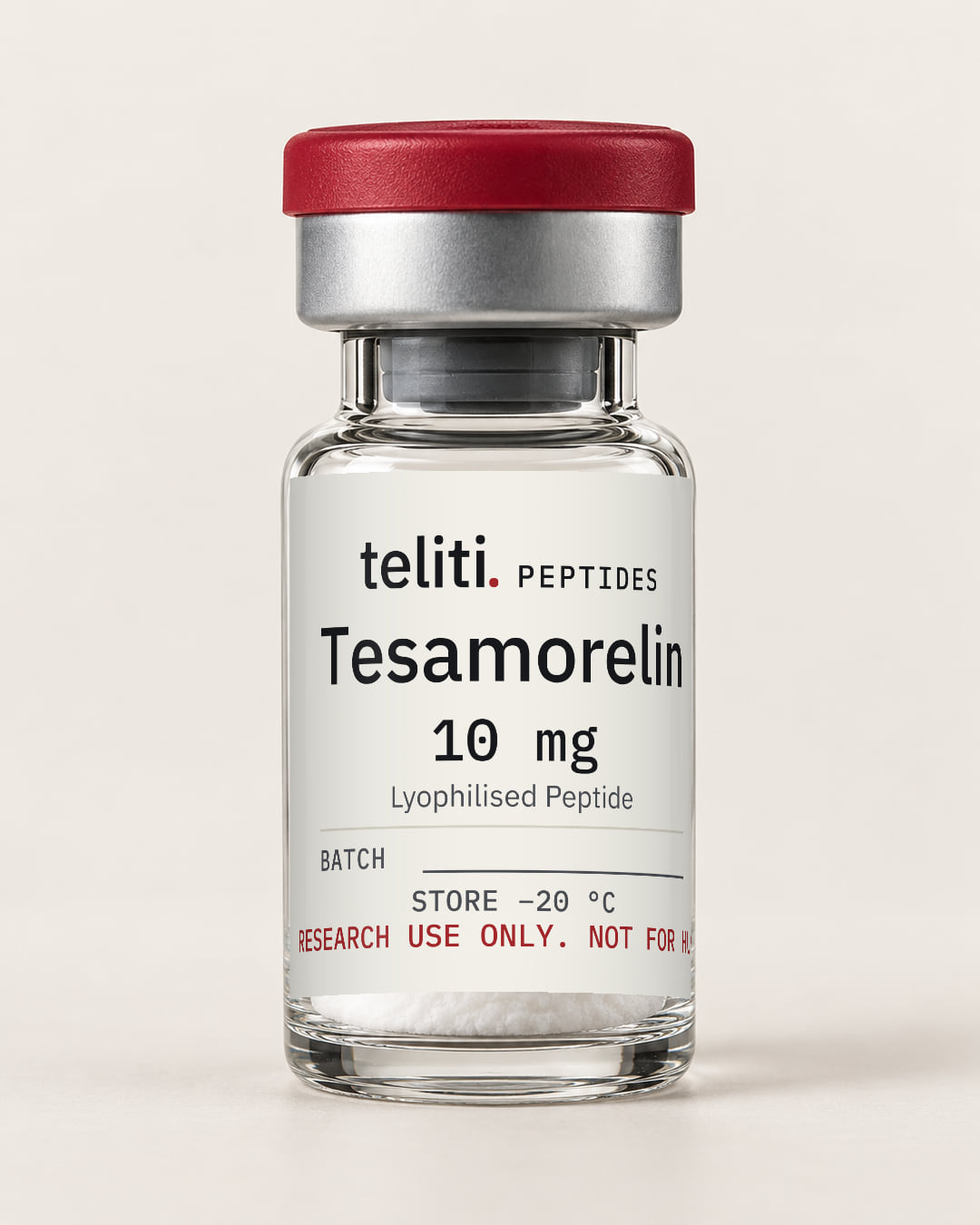
Tesamorelin is a stabilised analogue of growth hormone-releasing hormone that stimulates growth hormone release from the pituitary. Its evidence comes mainly from randomised trials in people with HIV, where it has an approved use in the United States.

What is tesamorelin?
Tesamorelin is a synthetic peptide of 44 amino acids, an analogue of human growth hormone-releasing hormone (GHRH) with a hexenoyl group added at the N-terminus. The modification protects it from the enzymes that break down natural GHRH quickly. It acts at the GHRH receptor in the pituitary, which releases growth hormone in response. Its identity data, from PubChem and the FDA substance register, are on the tesamorelin page.
What did the pivotal trial measure?
The main trial was published in the New England Journal of Medicine in 2007. It enrolled 412 patients with HIV and abdominal fat accumulation and ran for 26 weeks, measuring visceral adipose tissue by CT scan. Insulin-like growth factor I (IGF-I), the marker that rises when growth hormone is released, was measured alongside it.
What have later studies looked at?
A 2014 randomised trial in JAMA, in 50 patients with HIV, measured liver fat as well as visceral fat over six months, and reported a transient rise in fasting glucose at two weeks. A 2017 pooled analysis in AIDS combined two phase 3 trials with 806 patients and compared liver enzymes between patients whose visceral fat responded and those whose did not.
Is tesamorelin an approved medicine?
Tesamorelin is approved in the United States, under the names Egrifta SV and Egrifta WR, for the reduction of excess abdominal fat in adults with HIV-associated lipodystrophy, according to the DailyMed labels. That approval covers the manufacturer's product for that indication. It does not describe research-grade material sold for laboratory use.
Which compounds are related?
Ipamorelin reaches growth hormone release through a different receptor, the ghrelin receptor. Both are in the growth hormone secretagogues category.
Cited studies
-
In a 26-week trial in 412 patients with HIV, visceral adipose tissue changed by -15.2% with tesamorelin versus +5.0% with placebo, and IGF-I rose by 81.0% versus a 5.0% fall.
Metabolic effects of a growth hormone-releasing factor in patients with HIV.. New England Journal of Medicine, 2007. doi:10.1056/NEJMoa072375 · PubMed 18057338
-
In a 6-month randomised trial of 50 patients, tesamorelin was associated with reduced visceral adipose tissue and liver fat compared with placebo; fasting glucose rose transiently at 2 weeks.
Effect of tesamorelin on visceral fat and liver fat in HIV-infected patients with abdominal fat accumulation: a randomized clinical trial.. JAMA, 2014. doi:10.1001/jama.2014.8334 · PubMed 25038357
-
In a pooled analysis of two phase 3 trials (806 patients), visceral-fat responders showed larger reductions in ALT and AST than non-responders at 26 weeks.
Visceral fat reduction with tesamorelin is associated with improved liver enzymes in HIV.. AIDS, 2017. doi:10.1097/QAD.0000000000001614 · PubMed 28832410